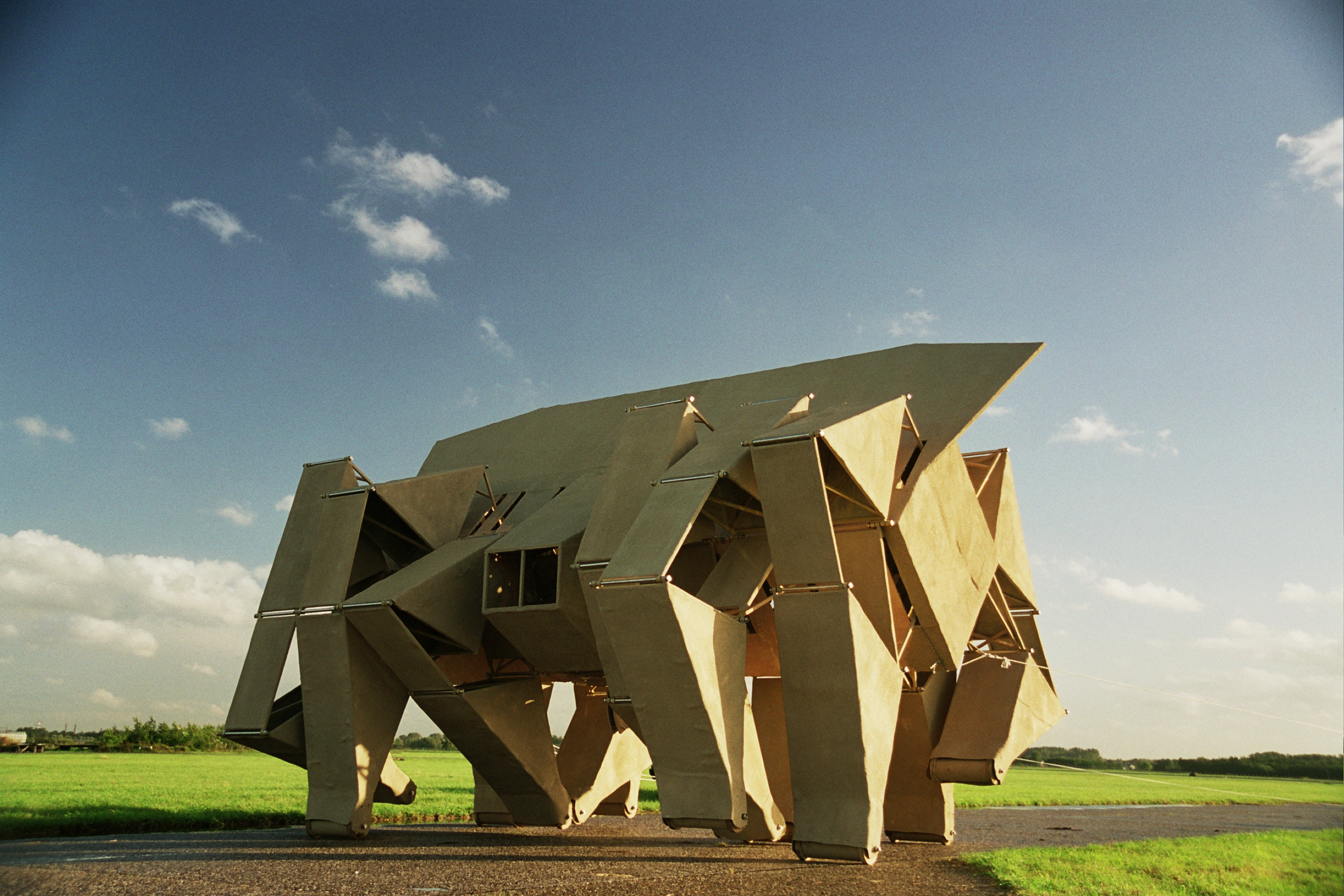
 This photo is of artist Theo Jansen's Rhinoceros and is brought to you by Octa, creators of the Whale Kit iPad Handle.
Humankind has a proud history of developing technology. Defined by the Greeks as technologia, it is the creation and use of tools, techniques, crafts and systems in order to solve problems or affect purposes. As soon as we humans recognized our mortality, we began using fire, clothing, and farming to distance ourselves from the vicissitudes of nature.
In the quest for comfort and material security, our species spent thousands of years separating itself from nature. Now designers are looking back to the natural world out of reverence for its evolutionary intelligence. Nature, it turns out, already has the solutions to many of our problems.
Biomimicry represents a major revolution in design, but it extends beyond aesthetics. It is also a revolution in thought. Biomimicry requires us to expand our definition of “intelligence” to include emergent properties of distributed systems. This means recognizing thinking forms very different from the human brain – including systems where “thoughts” are computed in parallel by many units and there is no bundle of nerves that can be called the center of decision-making. Google, a predominant example of distributed intelligence, is a coral-like colonial super-organism. According to the popular science of emergence, Google might be called an infant world mind. On the local level, methods of networking consumer electronics already imitate biology. The more we rely on hard drives and servers to store our personal information, the more we notice “network intelligence” in the hormonal communication between and among plants and fungi – and the better we grasp the alien neural architectures of octopuses and other cephalopods. Even in the human body, thought is distributed throughout a surprising number of systems: memories are stored in the heart, and the gut is home to a larger neural network than the brain itself. Each of us is a modular multitude of cooperative sub-processes.
By turning to our planet’s library of evolutionary solutions, we re-draw the boundary between “created” and “discovered.” We actively bring our questions to evolution itself and have them answered. Pioneers in artificial intelligence, instead of using brute force to program sentient life, now design evolving networks that adapt creatively to selected constraints – growing minds with which we already live in symbiosis. Injecting new intentionality into the evolutionary process, we make nonsense out of the old distinctions between “evolved” and “designed.”
Many authors argue that the distinction between “evolved” and “designed” is irrelevant. Humans—as the sense organs of an evolving, self-conscious universe—are technology. Our machines are an extension of the seamless process of our evolution.
Biomimicry is the first step in a new relationship where humans consciously consult the living world as an extension of our own minds. By the same coin, we recognize ourselves as extensions of a minded living world. Biomimicry returns us, after centuries, to the archaic way of seeing in which our world is alive and aware, thoughtful, companionable, and wise. Rather than trying to build dams, we can return to the stream of evolutionary intelligence and allow ourselves to swim in its flow.
More on that in a week.
This photo is of artist Theo Jansen's Rhinoceros and is brought to you by Octa, creators of the Whale Kit iPad Handle.
Humankind has a proud history of developing technology. Defined by the Greeks as technologia, it is the creation and use of tools, techniques, crafts and systems in order to solve problems or affect purposes. As soon as we humans recognized our mortality, we began using fire, clothing, and farming to distance ourselves from the vicissitudes of nature.
In the quest for comfort and material security, our species spent thousands of years separating itself from nature. Now designers are looking back to the natural world out of reverence for its evolutionary intelligence. Nature, it turns out, already has the solutions to many of our problems.
Biomimicry represents a major revolution in design, but it extends beyond aesthetics. It is also a revolution in thought. Biomimicry requires us to expand our definition of “intelligence” to include emergent properties of distributed systems. This means recognizing thinking forms very different from the human brain – including systems where “thoughts” are computed in parallel by many units and there is no bundle of nerves that can be called the center of decision-making. Google, a predominant example of distributed intelligence, is a coral-like colonial super-organism. According to the popular science of emergence, Google might be called an infant world mind. On the local level, methods of networking consumer electronics already imitate biology. The more we rely on hard drives and servers to store our personal information, the more we notice “network intelligence” in the hormonal communication between and among plants and fungi – and the better we grasp the alien neural architectures of octopuses and other cephalopods. Even in the human body, thought is distributed throughout a surprising number of systems: memories are stored in the heart, and the gut is home to a larger neural network than the brain itself. Each of us is a modular multitude of cooperative sub-processes.
By turning to our planet’s library of evolutionary solutions, we re-draw the boundary between “created” and “discovered.” We actively bring our questions to evolution itself and have them answered. Pioneers in artificial intelligence, instead of using brute force to program sentient life, now design evolving networks that adapt creatively to selected constraints – growing minds with which we already live in symbiosis. Injecting new intentionality into the evolutionary process, we make nonsense out of the old distinctions between “evolved” and “designed.”
Many authors argue that the distinction between “evolved” and “designed” is irrelevant. Humans—as the sense organs of an evolving, self-conscious universe—are technology. Our machines are an extension of the seamless process of our evolution.
Biomimicry is the first step in a new relationship where humans consciously consult the living world as an extension of our own minds. By the same coin, we recognize ourselves as extensions of a minded living world. Biomimicry returns us, after centuries, to the archaic way of seeing in which our world is alive and aware, thoughtful, companionable, and wise. Rather than trying to build dams, we can return to the stream of evolutionary intelligence and allow ourselves to swim in its flow.
More on that in a week.
Biomimicry and the Design Revolution: the New Intelligence
This photo is of artist Theo Jansen's Rhinoceros and is brought to you by Octa, creators of the Whale Kit iPad Handle.
Humankind has a proud history of developing technology. Defined by the Greeks as technologia, it is the creation and use of tools, techniques, crafts and systems in order to solve problems or affect purposes. As soon as we humans recognized our mortality, we began using fire, clothing, and farming to distance ourselves from the vicissitudes of nature.
In the quest for comfort and material security, our species spent thousands of years separating itself from nature. Now designers are looking back to the natural world out of reverence for its evolutionary intelligence. Nature, it turns out, already has the solutions to many of our problems.
Biomimicry represents a major revolution in design, but it extends beyond aesthetics. It is also a revolution in thought. Biomimicry requires us to expand our definition of “intelligence” to include emergent properties of distributed systems. This means recognizing thinking forms very different from the human brain – including systems where “thoughts” are computed in parallel by many units and there is no bundle of nerves that can be called the center of decision-making. Google, a predominant example of distributed intelligence, is a coral-like colonial super-organism. According to the popular science of emergence, Google might be called an infant world mind. On the local level, methods of networking consumer electronics already imitate biology. The more we rely on hard drives and servers to store our personal information, the more we notice “network intelligence” in the hormonal communication between and among plants and fungi – and the better we grasp the alien neural architectures of octopuses and other cephalopods. Even in the human body, thought is distributed throughout a surprising number of systems: memories are stored in the heart, and the gut is home to a larger neural network than the brain itself. Each of us is a modular multitude of cooperative sub-processes.
By turning to our planet’s library of evolutionary solutions, we re-draw the boundary between “created” and “discovered.” We actively bring our questions to evolution itself and have them answered. Pioneers in artificial intelligence, instead of using brute force to program sentient life, now design evolving networks that adapt creatively to selected constraints – growing minds with which we already live in symbiosis. Injecting new intentionality into the evolutionary process, we make nonsense out of the old distinctions between “evolved” and “designed.”
Many authors argue that the distinction between “evolved” and “designed” is irrelevant. Humans—as the sense organs of an evolving, self-conscious universe—are technology. Our machines are an extension of the seamless process of our evolution.
Biomimicry is the first step in a new relationship where humans consciously consult the living world as an extension of our own minds. By the same coin, we recognize ourselves as extensions of a minded living world. Biomimicry returns us, after centuries, to the archaic way of seeing in which our world is alive and aware, thoughtful, companionable, and wise. Rather than trying to build dams, we can return to the stream of evolutionary intelligence and allow ourselves to swim in its flow.
More on that in a week.