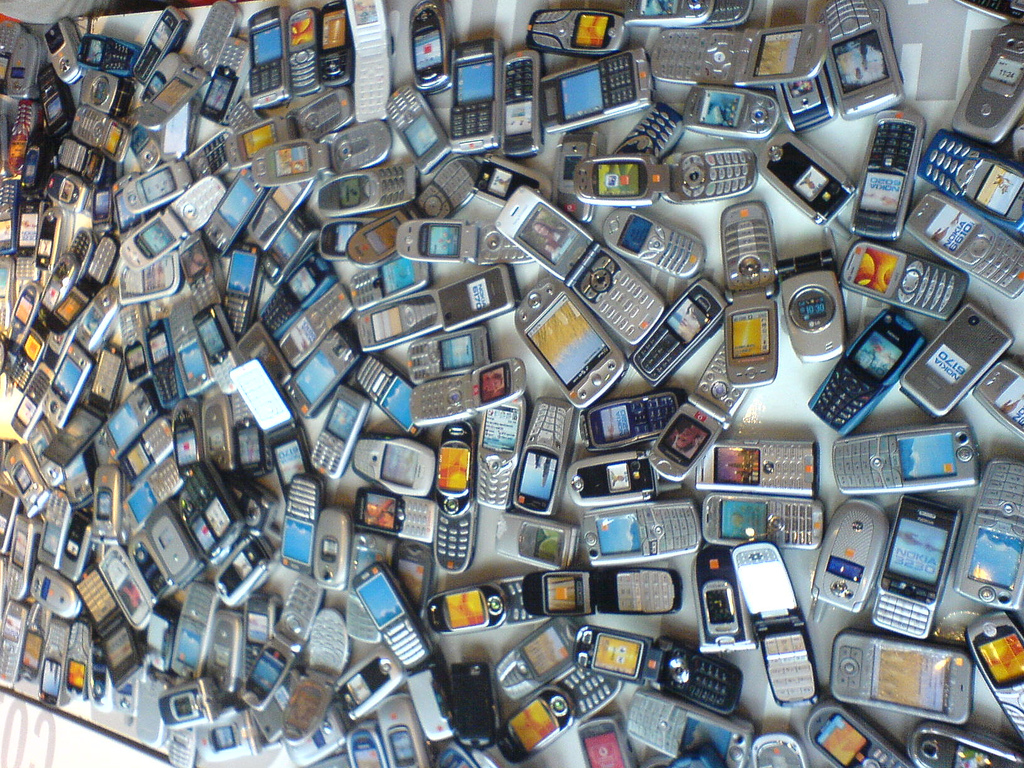
 (Photo Courtesy of Dave Patten)
In the 2006 comedy Idiocracy, Mike Judge depicts the Great Garbage Avalanche of 2505. That falling mass is almost certainly full of original iPads, first generation iPods, and antiquated iPhones, along with device-specific chargers and trashed FM transmitters. Technological advances have their costs. More pernicious than the stylized movie threats of new weapons or rampaging dinosaur clones, we face a not-so-subtle and advancing threat: the exponential growth of stuff.
This is the environmental impact of planned obsolescence, or the design practice of deliberately providing a product with a limited useful life. Items are created with intentional shortcomings to force users to make ancillary purchases. It’s no surprise that the sale of consumer electronics accessories represents $10 billion in annual revenue. Most consumers plan to use their accessories for a few years, but when the form factor, or geometry of a product, shifts from generation to generation—common among smartphones—accessory purchases may become more regular. Think of all those dead dongles: DisplayPorts replaced by Mini DisplayPorts, FireWire replaced by Thunderbolt.
Our minimalist visions of gleaming starship bridges are in stark contrast to this rat’s nest of wires and adapters. There is hope, however, that this inelegant mess is on the verge of a radical reorganization. In chaos theory, systems on the verge of transformation tend toward wilder, noisier behavior. Imagine a wobbling top right before it falls.
The work of Harvard mathematician and biologist Martin Nowak supports this hypothesis. In his work on the evolution of syntax in human language, he turned to the science of emergence – how greater levels of order and complexity appear from the interactions of simpler parts. Nowak argues that at some point in human development, the number of situations we needed to describe exceeded our ability to easily remember a new word for each scenario. It became easier to develop new parts of speech and combine them for a multiplying effect than to continue creating distinct calls.
“Lion behind you!”
“Lion in front of you!”
“Lion on your left!”
“Lion on your OS X!”
Humans were suddenly able to talk about many different kinds of lions, and to apply locational descriptors to any number of objects, without having to memorize a new term for every situation.
This is what makes written Chinese so much more difficult to learn than English. Chinese, as an older language, uses hundreds of pictographs to identify every unique referent, whereas English has only twenty-six letters that can be endlessly reassembled to make new words.
Likewise, the most sensible designers are dedicated to creating multiple-function technologies. First came the Swiss-Army Knife, then a screwdriver with interchangeable bits. Now television programming is available online, eliminating the need to purchase both a computer and a dedicated TV monitor. We no longer need to carry a discman and a cellular phone, along with a note pad, a pocket calendar and a flashlight. A single smartphone puts all of these functions and more at our fingertips. We can now read under the starlight with a backlit iPad, then check the names of said stars on the same iPad, built with more computer power than NASA used to reach the Moon.
Technologies like the tablet and the smartphone, while still indulging in some planned obsolescence, set exemplary standards for multi-functional devices. Now products in the accessories category must catch up. By creating accessories that are form factor independent—that work on an original iPad or an iPad 2, a Galaxy Tab or a Kindle—designers contribute to a harmonized language, instead of a cacophony of one-use words. By inventing ecosystems of accessories with interchangeable functions, developers demonstrate consideration for the consumer and the environment. By releasing updates and upgrades that are backwards compatible, they accomplish the same.
Nowak’s logic is indisputable. We may not all have tricorders yet, but as our increasingly complex world demands an emergent syntax of stuff, there will come a day when planned obsolescence is a thing of the past. Smart devices will interact intelligently to evolve new functions, and smart accessories will interface comfortably with the human body to create a seamless digital experience.
(Photo Courtesy of Dave Patten)
In the 2006 comedy Idiocracy, Mike Judge depicts the Great Garbage Avalanche of 2505. That falling mass is almost certainly full of original iPads, first generation iPods, and antiquated iPhones, along with device-specific chargers and trashed FM transmitters. Technological advances have their costs. More pernicious than the stylized movie threats of new weapons or rampaging dinosaur clones, we face a not-so-subtle and advancing threat: the exponential growth of stuff.
This is the environmental impact of planned obsolescence, or the design practice of deliberately providing a product with a limited useful life. Items are created with intentional shortcomings to force users to make ancillary purchases. It’s no surprise that the sale of consumer electronics accessories represents $10 billion in annual revenue. Most consumers plan to use their accessories for a few years, but when the form factor, or geometry of a product, shifts from generation to generation—common among smartphones—accessory purchases may become more regular. Think of all those dead dongles: DisplayPorts replaced by Mini DisplayPorts, FireWire replaced by Thunderbolt.
Our minimalist visions of gleaming starship bridges are in stark contrast to this rat’s nest of wires and adapters. There is hope, however, that this inelegant mess is on the verge of a radical reorganization. In chaos theory, systems on the verge of transformation tend toward wilder, noisier behavior. Imagine a wobbling top right before it falls.
The work of Harvard mathematician and biologist Martin Nowak supports this hypothesis. In his work on the evolution of syntax in human language, he turned to the science of emergence – how greater levels of order and complexity appear from the interactions of simpler parts. Nowak argues that at some point in human development, the number of situations we needed to describe exceeded our ability to easily remember a new word for each scenario. It became easier to develop new parts of speech and combine them for a multiplying effect than to continue creating distinct calls.
“Lion behind you!”
“Lion in front of you!”
“Lion on your left!”
“Lion on your OS X!”
Humans were suddenly able to talk about many different kinds of lions, and to apply locational descriptors to any number of objects, without having to memorize a new term for every situation.
This is what makes written Chinese so much more difficult to learn than English. Chinese, as an older language, uses hundreds of pictographs to identify every unique referent, whereas English has only twenty-six letters that can be endlessly reassembled to make new words.
Likewise, the most sensible designers are dedicated to creating multiple-function technologies. First came the Swiss-Army Knife, then a screwdriver with interchangeable bits. Now television programming is available online, eliminating the need to purchase both a computer and a dedicated TV monitor. We no longer need to carry a discman and a cellular phone, along with a note pad, a pocket calendar and a flashlight. A single smartphone puts all of these functions and more at our fingertips. We can now read under the starlight with a backlit iPad, then check the names of said stars on the same iPad, built with more computer power than NASA used to reach the Moon.
Technologies like the tablet and the smartphone, while still indulging in some planned obsolescence, set exemplary standards for multi-functional devices. Now products in the accessories category must catch up. By creating accessories that are form factor independent—that work on an original iPad or an iPad 2, a Galaxy Tab or a Kindle—designers contribute to a harmonized language, instead of a cacophony of one-use words. By inventing ecosystems of accessories with interchangeable functions, developers demonstrate consideration for the consumer and the environment. By releasing updates and upgrades that are backwards compatible, they accomplish the same.
Nowak’s logic is indisputable. We may not all have tricorders yet, but as our increasingly complex world demands an emergent syntax of stuff, there will come a day when planned obsolescence is a thing of the past. Smart devices will interact intelligently to evolve new functions, and smart accessories will interface comfortably with the human body to create a seamless digital experience.
An Emergent Syntax of Stuff
(Photo Courtesy of Dave Patten)
In the 2006 comedy Idiocracy, Mike Judge depicts the Great Garbage Avalanche of 2505. That falling mass is almost certainly full of original iPads, first generation iPods, and antiquated iPhones, along with device-specific chargers and trashed FM transmitters. Technological advances have their costs. More pernicious than the stylized movie threats of new weapons or rampaging dinosaur clones, we face a not-so-subtle and advancing threat: the exponential growth of stuff.
This is the environmental impact of planned obsolescence, or the design practice of deliberately providing a product with a limited useful life. Items are created with intentional shortcomings to force users to make ancillary purchases. It’s no surprise that the sale of consumer electronics accessories represents $10 billion in annual revenue. Most consumers plan to use their accessories for a few years, but when the form factor, or geometry of a product, shifts from generation to generation—common among smartphones—accessory purchases may become more regular. Think of all those dead dongles: DisplayPorts replaced by Mini DisplayPorts, FireWire replaced by Thunderbolt.
Our minimalist visions of gleaming starship bridges are in stark contrast to this rat’s nest of wires and adapters. There is hope, however, that this inelegant mess is on the verge of a radical reorganization. In chaos theory, systems on the verge of transformation tend toward wilder, noisier behavior. Imagine a wobbling top right before it falls.
The work of Harvard mathematician and biologist Martin Nowak supports this hypothesis. In his work on the evolution of syntax in human language, he turned to the science of emergence – how greater levels of order and complexity appear from the interactions of simpler parts. Nowak argues that at some point in human development, the number of situations we needed to describe exceeded our ability to easily remember a new word for each scenario. It became easier to develop new parts of speech and combine them for a multiplying effect than to continue creating distinct calls.
“Lion behind you!”
“Lion in front of you!”
“Lion on your left!”
“Lion on your OS X!”
Humans were suddenly able to talk about many different kinds of lions, and to apply locational descriptors to any number of objects, without having to memorize a new term for every situation.
This is what makes written Chinese so much more difficult to learn than English. Chinese, as an older language, uses hundreds of pictographs to identify every unique referent, whereas English has only twenty-six letters that can be endlessly reassembled to make new words.
Likewise, the most sensible designers are dedicated to creating multiple-function technologies. First came the Swiss-Army Knife, then a screwdriver with interchangeable bits. Now television programming is available online, eliminating the need to purchase both a computer and a dedicated TV monitor. We no longer need to carry a discman and a cellular phone, along with a note pad, a pocket calendar and a flashlight. A single smartphone puts all of these functions and more at our fingertips. We can now read under the starlight with a backlit iPad, then check the names of said stars on the same iPad, built with more computer power than NASA used to reach the Moon.
Technologies like the tablet and the smartphone, while still indulging in some planned obsolescence, set exemplary standards for multi-functional devices. Now products in the accessories category must catch up. By creating accessories that are form factor independent—that work on an original iPad or an iPad 2, a Galaxy Tab or a Kindle—designers contribute to a harmonized language, instead of a cacophony of one-use words. By inventing ecosystems of accessories with interchangeable functions, developers demonstrate consideration for the consumer and the environment. By releasing updates and upgrades that are backwards compatible, they accomplish the same.
Nowak’s logic is indisputable. We may not all have tricorders yet, but as our increasingly complex world demands an emergent syntax of stuff, there will come a day when planned obsolescence is a thing of the past. Smart devices will interact intelligently to evolve new functions, and smart accessories will interface comfortably with the human body to create a seamless digital experience.